<?xml version='1.0' encoding='utf-8' ?>
<feed xmlns="http://www.w3.org/2005/Atom">
<title>Social Memory Complex: law-of-one</title>
<link href="https://www.socialmemorycomplex.net/tags/law-of-one/feed.xml" rel="self" />
<link href="https://www.socialmemorycomplex.net/tags/law-of-one/" />
<updated>2026-05-24T21:17:06+00:00</updated>
<id>https://www.socialmemorycomplex.net/tags/law-of-one/</id>
<entry>
  <title>Wandering upon the Affective Terrain</title>
  <link href="http://socialmemorycomplex.net/2016/09/08/wandering-the-affective-terrain/" />
  <updated>2016-09-08T00:00:00+00:00</updated>
  <id>http://socialmemorycomplex.net/2016/09/08/wandering-the-affective-terrain/</id>
  <author><name>Jeremy Weiland</name></author>
  <content type="html"><![CDATA[<p>Pema Chodron’s <a href="https://www.lionsroar.com/pema-chodron-what-to-do-when-the-going-gets-rough/">What to Do When the Going Gets Rough</a> has had a great deal of influence in my daily life.  It appears to me that in meeting the difficulties of life we are faced with several levels of experience.  In order to process this stuff we harvest from our waking lives, we need more than just the mind, and Chodron has given me novel tools to do just this.</p>

<p>I’m fascinated by the way Bhuddist thought aligns with my chosen philosophy of life and spirit, but the most intriguing aspect for me is the praxis of Bhuddism.  While much spiritual information can seem unmoored from and hovering over the material life, Bhuddism has a wealth of accumulated practices, strategies, techniques, and attitudes that seem to be able to ground the subtle and intangible in the daily go-round.  Chodron’s article was the first that really woke me up to how much help there is available when we seem to be floating in mid-air.</p>

<p>The great lesson I feel I’m now learning is that of appreciating emotion.  I’ve often approached it in the past in much the same way an objectivist might: that our emotions are reflections of the quality of our thinking.  According to this attitude, a difficult emotion is a sign of some problem to be addressed, and the purpose of addressing it is to attain forward progress by overcoming or purging it.  It is no exaggeration to describe my former regard for emotions as one regards noise in the signal.</p>

<p>It was Steven Tyman’s <a href="https://www.amazon.com/Fools-Phenomenology-Archetypes-Spiritual-Evolution/dp/0761833560">A Fool’s Phenomenology: Archetypes of Spiritual Evolution</a> that really opened my eyes to another possibility.  Tyman is quite emphatic about the vital nature of the emotions, not as obstacles to be overcome or distortions to be vacated but as <em>sources of information</em> that can communicate what we cannot rationally or intellectually apprehend.  In fact, emotions are not even something we properly generate; instead they blow in of their own seeming accord, and we are utterly subject to them.  To respect emotions, I suppose, is to grant them their own space in life.</p>

<p>Two alternatives to acceptance occur to me: either (1) <em>repressing</em> this energy by ignoring it, locking it down and using discipline and control to keep it at arms length, or (2) <em>expressing</em> it in a kneejerk, reactive manner that so often seems to leave us worse off but at least lets the energy flow onward.  Both paths, turning emotion further inward and turning it further outward, seem to have as their end a desire for finality and resolution, to dislocate the emotion.  The urgency of emotion compels us to react in one of these two extreme manners, neither healthy.</p>

<p>Chodron’s article calls these two approaches out for their common end: the desire for bringing the pain, the tension, the edginess to a close.  But this reflects a conceit that <em>we can resolve emotions</em>.  While attempting to do so is a great teacher, one eventually must face the truth: these emotions cannot simply be disposed at our convenience.  They will have their say.</p>

<p>Now, one can ignore any source of information, be it an announcement from outside, a flare of pain in our bodies, a letter we receive, etc.  What we gain by avoiding the emotional information is the chance to avoid the edginess, tension, and lack of solid footing that attend emotions.  What we obviously lose is what the emotion would teach us about ourselves, but we also forgo the ability to act upon a third option: that of simply <em>allowing the emotion to abide</em>, and learning how to allow that to occur without the need for extreme measures.</p>

<p>Chodron tenderly points out that it is precisely this extended discomfort that teaches.  When we learn to sit with our feelings, not by imprisoning or evicting them but simply by accepting all of their nastiness and spikyness and sinking-ness, we find that it is here that true spiritual growth comes into play.  For perhaps it is that emotions come at us from nowhere precisely because we have vast resources that waking consciousness cannot always seat.  We find, in other words, that we cannot think these problems; we must rely upon other resources that are no less us, no less helpful.  Repression and reflexive expression does not “resolve” anything; it just delays the pain as well as the learning the pain delivers.  Genuine growth is never convenient.</p>

<p>And then there is the point about recognizing others’ emotional reactions and seeing a mirror for the lessons we’re grappling with.</p>

<blockquote>
  <p>Recognize that, just like us, millions are burning with the fire of aggression. We can sit with the intensity of the anger and let its energy humble us and make us more compassionate.</p>
</blockquote>

<p>If nothing else, Chodron convinced me our helplessness in the face of emotion is a reason to be more patient not just with ourselves but with others.  None of us come out of the “fire of aggression” unsinged; allowing others to work through emotion at their level provides us valuable experience and feedback, since it’s hard to see somebody emote without emoting along with them to some degree.  Indeed, I think emotion has often confounded me precisely because of its contagious nature.  But we’re not “catching” something from another really; all that’s happening is that we’re being reminded of our own feelings and unresolved issues.  If one is apt to ignore them within, then the reflection from without is most assuredly a disturbing report.</p>

<p>So what we’re really playing with here is the directionality of our attention, moving it away from escape from emotion and towards diving head-first into emotion.  Others’ unhinged emotions would not bother us if we were ourselves balanced.  But when we lie to ourselves about our affective health, it can be absolutely flooring when we discover how easily our buttons are pushed.  This is not a failing, though; it is once again merely information that we can use to understand ourselves better.  In that way, we receive a true gift from others “freaking out”, reminding us how compassion, understanding, and patience are genuine silver bullets (if slow moving projectiles) in these situations.</p>

<p>This was a big wake-up call for yours truly, even as I acknowledge many probably find this insight abjectly trivial.  So often I have approached emotion in the human condition as some mistake to be corrected.  That emotion could simply constitute a way of wrestling with realities, in the same way I wrestle with ideas in the mind, floored me.  Additionally, Chodron described that indeterminate, uncomfortable feeling so well that it was easy to recognize and make the connection in my own life.</p>

<blockquote>
  <p>Right at the point when we are about to blow our top or withdraw into oblivion, we can remember this: we are warriors-in-training being taught how to sit with edginess and discomfort. We are being challenged to remain and to relax where we are.</p>
</blockquote>

<p>This advice finally strikes me as very similar to the <a href="https://www.lawofone.info/results.php?s=5#2">balancing exercises discussed in the Law of One material</a>, where instead of trying to overcome feelings we actually sit with them, mentally intensify them to the extreme, and then intensify the opposite emotion to to the extreme:</p>

<blockquote>
  <p>To begin to master the concept of mental discipline it is necessary to examine the self. The polarity of your dimension must be internalized. Where you find patience within your mind you must consciously find the corresponding impatience and vice versa. Each thought that a being has, has in its turn an antithesis. The disciplines of the mind involve, first of all, identifying both those things of which you approve and those things of which you disapprove within yourself, and then balancing each and every positive and negative charge with its equal. The mind contains all things. Therefore, you must discover this completeness within yourself.</p>
</blockquote>

<p>The goal is to have a balance of emotion in our lives, to appreciate all 360 degrees of emotion, both the pleasant and unpleasant ones.  This is in no way, shape, or form an absence of, or escape from, emotion.  To understand the full spectrum of affect is to familiarize oneself with the potentials out there which will meet us as we serve others more and more purely and thoroughly.  As the aforementioned material states elsewhere, it’s really about self-acceptance.  If we know ourselves–not as we’d wish ourselves to be, but as we truly are, warts and all–we have no buttons to push, or as Chodron describes it, “we don’t set up the target for the arrow.”</p>

<p>For instance, I have real issues with feeling bossed around and controlled.  The other day I encountered this feeling and, instead of responding to the proximate cause, I just allowed myself to feel that way as much as I could.  I tried really hard to make sure I wasn’t pushing the feeling down, but instead letting the horrible feeling fester.  I focused and tried to intensify the feeling, really being with it.  What I found is that this gave me an <em>incredible</em> sense of agency and empowerment!  I realized that lashing out in the past never made me feel powerful, it usually only served to communicate how controlled and unhappy I felt, and poorly at that.  Conversely, feeling the emotion deeply made me realize <em>all</em> the possible choices available to me, which made me realize how many opportunities I have ignored in the past, so bent was I on ending the pain.  Enduring the pain, honoring it, bringing my attention to bear on it–it’s amazing how much simple presence introduces you to a different side of yourself.</p>

<p>It is a really weird sensation, I must say, to feel a negative emotion and to let it simply occur to oneself, not trying to avoid it in some way or dislodge it through lashing out at phenomenal reality.  I continue practicing this discipline poorly.  But just knowing that there is a mode in which undesired emotions can benefit me, one in which I can be accepting towards myself for being exactly the kind of self I have often disparaged… well, that insight might be more valuable than anything else I’ve recounted on this blog.</p>
]]></content>
</entry><entry>
  <title>The Only Way to Win the Game</title>
  <link href="http://socialmemorycomplex.net/2012/07/01/the-only-way-to-win-the-game/" />
  <updated>2012-07-01T00:00:00+00:00</updated>
  <id>http://socialmemorycomplex.net/2012/07/01/the-only-way-to-win-the-game/</id>
  <author><name>Jeremy Weiland</name></author>
  <content type="html"><![CDATA[<p>I’ve been doing a lot of work on the blog infrastructure lately, including augmenting the <a href="/tags">tag system</a> and updating my <a href="/links.html">links page</a>. Most of my blogroll and links from the old Wordpress site got lost, so I’m trying to put together something that represents all my interests and the blogs and sites I read and support. I rediscovered <a href="https://lawofone.info">lawofone.info</a> which is an awesome web application my friend Tobey Wheelock put together to make the Law of One material indexable, searchable, and categorized. He’s also used it to compile <a href="https://lawofone.info/relistening-report.php">his work on relistening to the original sessions</a> and he’s picking up some <a href="https://lawofone.info/relistening-report.php#most-significant">interesting corrections</a> to <a href="https://llresearch.org/library/the_law_of_one_pdf/the_law_of_one_pdf.aspx">the original text</a>. It’s really cool to see the material go from one guarded by a few people to a crowd-sourced collaborative rediscovery of the source.</p>

<p>Anyway, Tobey also has a page of interesting quotes and I found <a href="https://lawofone.info/results.php?s=50&amp;v=e&amp;ss=1#7">one of my favorites</a>. One of the things that really appeals to me about this way of looking at the human condition is that it reconciles waking life with a greater reality in a way that doesn’t require you to really believe in any concrete metaphysics or afterlife or anything fancy. The focus is not on heaven or hell but on making the best use of the tool of human incarnation. Getting new agey people to appreciate their mundane human experience – not in contradiction to but as itself the spiritual teleology they seek – prioritizes self-knowledge over system- or doctrine-knowledge. Spirituality should be something you engage in to satisfy your own needs, not to conform to a system that will fill in the blanks for you.</p>

<p>So why is our human condition the way it is, if we are all genuinely one? Why do we have these short lives trapped in finite bodies with limited senses if we are, indeed, infinite in reality? Because there is a utility in our ignorance, something we can learn in this constrained experience that we can’t learn in any other way:</p>

<blockquote>
  <p>Let us give the example of the man who sees all the poker hands. He then knows the game. It is but child’s play to gamble, for it is no risk. The other hands are known. The possibilities are known and the hand will be played correctly but with no interest.</p>
</blockquote>

<blockquote>
  <p>In time/space and in the true-color green density (in other words, beyond our incarnate reality - JPW), the hands of all are open to the eye. The thoughts, the feelings, the troubles, all these may be seen. There is no deception and no desire for deception. Thus much may be accomplished in harmony but the mind/body/spirit gains little polarity from this interaction.</p>
</blockquote>

<blockquote>
  <p>Let us re-examine this metaphor and multiply it into the longest poker game you can imagine, a lifetime. The cards are love, dislike, limitation, unhappiness, pleasure, etc. They are dealt and re-dealt and re-dealt continuously. You may, during this incarnation begin – and we stress begin – to know your own cards. You may begin to find the love within you. You may begin to balance your pleasure, your limitations, etc. However, your only indication of other-selves’ cards is to look into the eyes.</p>
</blockquote>

<blockquote>
  <p>You cannot remember your hand, their hands, perhaps even the rules of this game. This game can only be won by those who lose their cards in the melting influence of love; can only be won by those who lay their pleasures, their limitations, their all upon the table face up and say inwardly: “All, all of you players, each other-self, whatever your hand, I love you.” This is the game: to know, to accept, to forgive, to balance, and to open the self in love. This cannot be done without the forgetting, for it would carry no weight in the life of the mind/body/spirit beingness totality.</p>
</blockquote>

<p>Much of what I advocate politically is but the prerequisites for a society in which such transparency and utter vulnerability could thrive. But I’m also reminded that this is not a political matter, in the final analysis. Rather, it is a matter of the self making a very fundamental choice about what to be and what to manifest. That choice is more important than all the revolutions I could want, and I must keep in mind that I should never let the political overshadow the true transformative power of the will and of love.</p>
]]></content>
</entry><entry>
  <title>Faith and Liberty</title>
  <link href="http://socialmemorycomplex.net/2011/03/09/faith-and-liberty/" />
  <updated>2011-03-09T00:00:00+00:00</updated>
  <id>http://socialmemorycomplex.net/2011/03/09/faith-and-liberty/</id>
  <author><name>Jeremy Weiland</name></author>
  <content type="html"><![CDATA[<p>I’ve often felt that my political principles are merely the application of beliefs and ideas that I hold on a deeper and more fundamental level. This quote does a better job of stating the relationship between the individual striving for spiritual understanding and the political striving for liberty than anything I’ve ever written:</p>

<blockquote>
  <p>Entities within your culture are fond of saying that humankind is made in the image and nature of the Creator. What image do we think of? What image comes to mind when one thinks of the Creator? That is a key question, and central to those who seek faith. For if a Creator is sought that is angry and punishing, righteous and full of justice, then we gaze at a part of ourselves, and if the Creator is gentle and nurturing and all embracing and unifying, then we gaze at a part of ourselves. Since there is a mystery, there is a choice to be made concerning one’s attitude towards that mystery. Those who feel instinctively that the Creator is an unifying, loving and nurturing Creator are those which discover faith in one way, that is the positive path of polarization through service to the infinite One and to other selves, the images of the infinite One. Those who choose to see the creator of judgment, righteousness and law, are those who wish control, control over the life, control over the self, control over others, that there be no surprises, but that all be reckoned ahead of time, safe and tidy. This is the path of separation. We are aware that we speak to those upon the positive path of polarization, and so we will address faith in its positive sense, that is, that faith does not begin with faith in the self, but faith in the Creator. (<a href="https://www.llresearch.org/transcripts/issues/1991/1991_0203.aspx">Hatonn, February 3, 1991</a>)</p>
</blockquote>
]]></content>
</entry><entry>
  <title>Thirtieth Anniversary of the Ra Contact</title>
  <link href="http://socialmemorycomplex.net/2011/01/15/thirtieth-anniversary-of-the-ra-contact/" />
  <updated>2011-01-15T00:00:00+00:00</updated>
  <id>http://socialmemorycomplex.net/2011/01/15/thirtieth-anniversary-of-the-ra-contact/</id>
  <author><name>Jeremy Weiland</name></author>
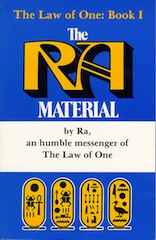
  <content type="html"><![CDATA[<p><img src="/images/ra.jpg" alt="The Ra Material Cover" title="The Ra Material" /></p>

<p>Ever since I started this blog I’ve occasionally referenced something called “the Law of One”, and I have received questions on what that actually is from time to time. Several concepts from this blog, including “social memory complex” and “6th density”, are from a body of work available from <a href="https://llresearch.org">L/L Research</a> known alternately as “The Ra Material” or “The Law of One”. These are transcriptions of conversations between a member of L/L Research and a claimed disincarnate entity calling itself “Ra” that occurred by means of trance channeling. Today is the thirtieth anniversary of that initial contact, and I’ve written a congratulatory letter to Carla Rueckert and Jim McCarty, the surviving members of L/L Research, which you can find <a href="/features/on-the-thirtieth-anniversary-of-the-ra-contact/">here</a>.</p>

<p>I have a history with channeled material. During my childhood my parents were very interested in so-called “new age” thought generally and the <a href="https://en.wikipedia.org/wiki/Edgar_Cayce">Edgar Cayce</a> channellings from the early 20th century in particular, and when I was in middle school I began to develop an interest in reading them. I had had some personal experiences that inspired a curiosity in spirituality and had parents who encouraged it. Cayce gave tens of thousands of deep trance psychic readings that resulted in countless cures that cannot be explained by any modern science. However, interspersed throughout those healing readings were other pieces of information. There was all sorts of stuff about ancient civilizations and technologies, past lives and reincarnation, and attempts to explain the nature of the human condition beyond what we experience on a day to day basis. I became enthralled by this window into a larger reality, part science fiction, part metaphysics.</p>

<p>As fantastic as all that information was, its real utility as a platform for learning about deeper spiritual insights served me much better than believing in Atlantis ever did. Ultimately, the value of the work is determined by how much use you can make of it, and the introspective spiritual truths conveyed were more actionable in my daily life and adolescent struggles than stuff about crystals and sunken continents. This willingness to look beyond the transient surface of metaphysical information to the deeper significance would be a great tool in my future efforts.</p>

<p>Towards adulthood I started reading other metaphysical materials: various theosophical books, other channeled materials, and pop new age stuff like The Celestine Prophecy. I was never dogmatic about any of this information, and the more widely I cast my net, the more easily I could see the common threads in the varied approaches. That made it much easier to come to my own conclusions about these matters instead of blindly following one book or another, though it’s probably fair to say that a certain amount of preoccupation with a given book is necessary to really absorb it.</p>

<p><a href="https://acim.org/">A Course in Miracles</a> was probably the work that made a deeper impression on me than any other I’d encountered up till then. It had been studied by my parents while I was growing up, but I didn’t find it until I was 16. It approached spirituality from a comparatively intellectual point of view, challenging my thinking directly instead of through archetype and metaphor. Channelled by a thoroughgoing materialist psychology professor, its <a href="https://www.facim.org/bookstore/p-3-absence-from-felicity-the-story-of-helen-schucman-and-her-scribing-of-a-course-in-miracles.aspx">story</a> is compelling all on its own. Suffice to say, while in the final equation spiritual exploration is not an  intellectual exercise, there is much work to be done in examining one’s thoughts.</p>

<p>I found the Law of One through <a href="https://divinecosmos.com">David Wilcock</a>, who did his own channeling and research. I moderated his Yahoo! group and became friends with him. He referenced the Ra material in his own work on alternative physics and spirituality, and most importantly he made available a <a href="https://www.spiritofra.com/Ra-section%201.htm">study guide</a> that broke down the Law of One material for better comprehension. Reading this first helped me tremendously, because the material is a transcription of conversations that build concepts gradually and it’s easy to develop a disjointed and confused understanding on initial readings. Also corresponding on the Yahoo! group was a great help, and I owe David a substantial debt for all his guidance.</p>

<p>The core of the Law of One material is the spiritual principle that all that we experience as separate entities are in fact one infinite entity and identity: the Creator. In short, all is the Creator and all is the self, so a loving attitude towards others is an expression of the reality of unity, not some mere altruistic duty. The seeming separation we experience in our waking lives has utility because we can learn things about ourselves / the Creator that we cannot otherwise learn. We are here to develop the capacity for love in spite of all the suffering and confusion of this world, because only here can these capacities be “polarized” to sufficient intensity to allow us to progress to the next level. This polarization is governed by a choice of how to express our nature as the Creator, positively and loving or negatively and fearful, and the two poles are commonly referred to as “service to others” and “service to self”. Both are valid paths back to unity, but they are different in quality, duration, and lessons.</p>

<p>The above is a tragically concise distillation of the Law of One material in its spiritual essence. I made sure I mentioned that first because the entity transmitting this information calls itself “Ra”, claims to be a highly evolved extraterrestrial “social memory complex” or group mind, and claims to have visited Earth thousands of years ago to help us but in doing so unwittingly introduced distorted understandings of the Creator. This mistake in the past is responsible for much suffering and confusion today through various cultural, social, religious, and political constructs, and those of Ra feel a responsibility to correct these errors. There is more of this cosmic drama mentioned in the material, what I call “space opera” details, but to me they are not nearly as important as the spiritual heart of the message. In other words, even if all the space drama were completely false, the philosophical content could still be valid.</p>

<p>L/L Research, composed of Carla Rueckert, Jim McCarty, and Don Elkins, had been doing experiments in telepathically contacting extraterrestrials and channeling all throughout the 60s and 70s. Essentially, those of Ra say they chose to contact the group because they had honed the art of trance channeling through their previous work, and their attitude and orientation was congruent with the group’s. One thing that sets the Law of One material apart from other channellings was that L/L Research attempted from the beginning to approach the contact as objectively and scientifically as possible, recording all contacts and making as much information and background available to others (with some exceptions for personal details) so they could reach their own conclusions. Because of this attitude of extreme transparency, the message could get through without the distortions that had been introduced in past contacts with humanity.</p>

<p>I don’t expect people to take my word for any of this or that they should even care. I certainly don’t consider this material the only source of truth, nor is any claim of exclusivity made on Ra’s part. It’s not important to me whether everything Ra says is 100% true; in fact, at one point those of Ra state that the more the conversation turns to so-called “transient” matters like UFO physics, paranormal phenomena, historical figures, and the like, the more likely the information is to be distorted. The more the requested information pertains to timeless, universal truths that transcend our culture and history and approach a more unified and infinite perspective, the more likely they are to be accurate. Indeed, Ra insisted <em>as a condition of the communication</em> that people judge the information for themselves and discard anything that did not resonate, lest they introduce distortion into our consciousness once more. Free will (what they call the “Law of Confusion”) is a very important part of our journey. This makes sense to me because it describes exactly what I’ve done throughout my exploration of different metaphysical strains of thought.</p>

<p>All I’ll say is that, as a friend once put it, discovering the Law of One material felt like slipping on an old pair of worn-in, comfortable shoes. It resonated with me at a very deep level. The backstory it gives for the spiritual utility of a seemingly mundane and definitely confusing life makes sense; that we’re here not just to be happy (though that’s part of it) but to be who we are, which is something more than we think we are. To me, the Ra material is a symbol of something more fundamental than a fantastic telepathic contact; it is a way of approaching spiritual evolution that can help one move towards a personal experience more authentic and instructive than any outwardly apprehended teaching.</p>

<p>It should be obvious that I’ve summarized quite a bit, even as this post has dragged on, but I want the reader to have some clue as to where I’m coming from. It’s not easy to talk about because it flies in the face of our everyday experience, but it’s part of who I am. Spirituality and seeking is at least as fundamental to me as the politics I write so much about, and indeed I see <a href="/features/the-political-implications-of-the-law-of-one.html">significant parallels</a> between the two.</p>

<p>I also want to convey why these people to whom I wrote the letter are so dear to me; the quality of the information they’ve brought through is so high in my opinion that I’m very grateful for their sacrifices and celebrate this day. Finally, I want people to get a glimpse into a body of work that I’ve found helpful, because maybe they’d find it helpful. What’s important is not channeling, or ETs, or particular models of a greater reality; rather, the most important thing is the desire to understand and develop the self. It is Ra’s ability to inspire the latter that assures me of the usefulness of this material, though you have to make up your own mind about it.</p>
]]></content>
</entry><entry>
  <title>The Unique One and the Universal</title>
  <link href="http://socialmemorycomplex.net/leftlibertarian/2010/08/16/the-unique-one-and-the-universal/" />
  <updated>2010-08-16T00:00:00+00:00</updated>
  <id>http://socialmemorycomplex.net/leftlibertarian/2010/08/16/the-unique-one-and-the-universal/</id>
  <author><name>Jeremy Weiland</name></author>
  <content type="html"><![CDATA[<p>Over the past two to three years, I’ve engaged in many conversations featuring the appeal to moral principles asserted to be held in common. Some who’ve known me for a while may notice that over this period I’ve begun to distance myself from appealing to these moral principles as a basis for my arguments. This has been a rule I’ve adhered to largely from both my own investigations of my beliefs as well as the influence of Max Stirner’s “The Ego and Its Own” (or, as Shawn Wilbur correctly points out is a better translation of the title, “The Unique One and Its Property”).</p>

<p>Stirner taught me that abstractions and concepts (“spooks”) often rule us just as completely and arbitrarily as corporeal authorities, and that true freedom requires one to break free of all preconceived notions of propriety, convention, and duty. This philosophy is often called “egoism” and is treated by many as a form of nihilistic realism culminating in an almost Nietzschean “will to power”. All constraints on the ego are to be discarded in order for the self to express itself fully through its property, its ideas.</p>

<p>This causes understandable concern in many. The search for perfect and complete freedom is framed in terms that are positively anti-social. If adhering to ethical codes or moral laws or legal statutes or social conventions should displease you, why not throw them all out? After all, what makes them all more valuable than your own happiness? And I find this a hard argument to reject without appealing to other spooks.</p>

<p>Indeed, I’ve come to realize that my own moral beliefs are undemonstrable and, therefore, I often have no compelling argument to make. For example, I believe the non-aggression axiom is a valid construct - it makes sense to me and seems to align with my innate sense of justice most of the time. But there’s no way to fashion a logical argument for this position outside of the conventions instilled in us through a lifetime of social experience, the nature we can claim to share (whatever that means), or the rhetorical power with which I can persuade, or make demands on, you.</p>

<p>If I want <em>you</em> to accept the axioms I accept, I don’t know where to begin, other than to presume you’re like me in important ways that allow my sensibilities to transfer over to you. The belief that we share common access to a universal basis for truth is the precondition for any persuasive, rational debate. It underlies the motivation for reaching out to you at all, because I assume you have the innate ability to reach the same conclusion I did - somehow. If I believe my position is true, I believe that you are <em>compelled</em> to accept it if you’re honestly accessing that same store of truth.</p>

<p>The idea that you and I are similar, that there’s an inner truth available to both of us that underlies our common interest in peace and harmony, and that this common truth is mutually accessible, is typically consigned to the domain of the religious, the mystical, the arena of doctrines requiring blind faith (though it has its secular versions, such as the rationalism of the Enlightenment era). And yet, the more deeply I’ve studied the arguments of libertarians (and I certainly believe this applies to any political ideology, or for that matter any belief system, bar none) the more clearly I see that ours is distinguished from others not by our beliefs per se so much as our constructions of that universal truth we expect others to access. Hence our outrage when they appear not to, because they are not simply disagreeing with us; they are challenging our own certainty in the truth at which we’ve arrived. After all, we would not reach out to them in the first place if we did not believe they (A) are honest with themselves and us, and (B) have equal access to that store of universal truth.</p>

<p>What’s weird about the typical construction of Stirner’s argument that appears to predominate in libertarian and anarchist circles is the emphasis on the quest to banish every kind of spook - <em>only to make room for the primacy of another</em>. It typically presumes a particular conception of the individual lying nascent and pure under these layers of spooks (particular at least to the degree that the spook’s restriction of it is identifiable) but never questions whether that conception of the individual as described by Stirner is itself a spook. Stirner advocates for this ego to dominate in exactly as arbitrary a manner as any other ideation can elevate itself within the psyche. In pushing for a radical individualism, Stirner seems to be convincing the reader not to abandon all the chains and limitations of the various spooks so much as to adopt one really powerful spook to rule them all, and let <em>that</em> ascendency be named “freedom”.</p>

<p>But what next? If you follow his ideas to their logical conclusion, a totally different construction can emerge. What if we, as the unique ones, create ourselves - not merely limit ourselves, though that seems to be part of it - through the duties, moral codes, and other constructs we assume? What if that is the character of our creative task? Perhaps casting off the spooks gets us down to the core of our being, but must we stop there? Or do we channel that core to others as an expression, a unique composition of identity and “will to self-definition”?</p>

<p>Perhaps all of us unique ones are defined not simply by our mere uniqueness at the root of it all, but the way in which we <em>fit together</em> as irreplaceable components. The ego as Stirner described it may in fact not be the unique one - it may be the spook we empower to protect ourselves from the inner truths others are constantly counter-demonstrating to us. If we are threatened by others’ constructions of their inner truth, it is only because we rely on the certainty of identification with our own spooks, which stand in for a more honest, rigorous, and continuous exploration of the self.</p>

<p>I maintain that the genuine political act is the quest for self-knowledge, or rather, a continual dedication to increasing honesty with oneself. The rest is arbitrary expressions people choose in order to get at that essential heart in others - indeed, if they didn’t assume the existence of that heart they wouldn’t bother to make the effort! Too often, they mistake the expressions for that which is being expressed, that which is truly being sought by all of us with various degrees of fidelity. You can argue ethics, morality, and logic all day with others and not convince anybody of anything nor discover anything that helps you better understand the human condition, because it is a condition of billions of unique truths, all equally valid.</p>

<p>In the same way that Nietzsche dared the individual to will himself to power, one can dare to create oneself by choosing his spooks, his constraints, his individual expressions of the universal as he understands it. It is an act of consummate creativity to define your own moral and ethical context as an expression of universal truth. The key, however, is to recognize that others do the same, and to see the interpersonal dialogue as a continuation of the meditation on the unique one - not some challenge to your ego. You approach the universal <em>through</em> the individual, not as a rejection of it.</p>

<p>If I express frustration with those who advocate for universal principles, such as particular conceptions of human rights, justice, moral codes, etc. it is not because I reject the reality of a transcendent universal truth. Instead, it has more to do with the manner in which some advocates appeal to it, as if their conception were binding on me. Often such arguments end up coming off more or less as breathless assertions of one’s ego, seeking conformity and not understanding, and certainly not an appeal to the common truth we should share.</p>

<p>In fact, it is precisely because of my firm grasp of what it means for a truth to be universal - that it has no need to be forced on another, either through the brute force of rhetoric or that of violence - that I do not insist on your consent to it. In fact, I welcome your dissent. We are each equally the conduits of the universal if we’re worth convincing at all. In order for me to be assured that I am articulating something “true”, the last thing I want to do is to extract your consent to my position. Above all, I want your honest feedback to help me integrate your unique insight into my search. The earnest seeker of truth places a higher value on <em>testing</em> it than merely <em>believing</em> in it.</p>

<p>Stirner closed his magnum opus with the phrase, “All things are nothing to me,” as if that were the end of the matter. Be that as it may, creativity and freedom end up manifesting most universally as the ability, nay, the <em>daring</em> to make something of that nothing, and to do it in the unique way only you can. That is a magnificent and glorious idea to me - indeed, it is what I believe I am, and what I believe you are.</p>

<p>It is why I will never demand you are compelled by some universal law “out there” to adopt my beliefs. Such arguments amount to hand waving, and no honest person resorts to them knowingly. For the precise reason that I believe some things are universal, I dare to trust you to find it yourself, in your own unique way - and if you can construct it better than I, then the benefits accrue to us both. It is in that manner of unique togetherness we approach a less distorted, more useful conception of the unnameable principle which impels us to associate in the first place.</p>
]]></content>
</entry>
</feed>
